Wednesday, 5 December 2012

MORE MINIMALISM...

Yet more downsizing...

Another quickie post, on a theme I've followed before.

Below are two D3S bodies, with Nikon Speedlights (OK, flashguns!) attached. One has my SB900 attached, the other the SB700.

D3S plus SB900, left, and D3S plus SB 700.
Notice a difference?

The SB900 is a huge piece of equipment. I'm not the first to suggest that it unbalances even the big, weighty D3 and D4 pro bodies.

Nikon's SB700, as you can see, is significantly smaller. It's not actually that much lighter, but it has such a more compact, lower profile that it feels tiny in comparison. Even the big camera bodies feel much more wieldy with it attached compared to its bigger brother.


There are a few differences;
the SB700 can't take an external power pack (I've stopped using these anyway because of the already fast recycle time of the newer flashes)
SB700 can't run mixed manual/TTL remote flashes, though it can at least act as a master/commander.

And it's about 1/2 stop less powerful.  Yep, ONLY about 1/2 stop.

As an on-camera unit, this one makes far more sense, most of the time, than the SB900.

And it's usefully cheaper, too.


Monday, 26 November 2012

Minimalist Marvel...

Downsizing isn't always bad...


My 3+ year-old MacBook has finally been replaced.

It's been my work machine for that time. Although I have a "works PC", it is a PC, is slow, minimally specc'ed and pretty much unused and unloved. I must be mad using my own kit but at least I do have stuff that does the required business. Happy photographer = creative photographer, I've found...

The old machine wasn't cutting edge when I bought it in April 2009. A 2Ghz dual-core processor, 160gb hard drive and 2gb of RAM, in the then-new aluminium unibody. I upgraded the RAM to the max 4gb via crucial.co.uk and it was used for editing, captioning, transmitting and pretty much everything else after that. Using Photo Mechanic and Lightroom 2, then latterly Aperture 3, it did everything I needed as a press photographer. Reliably, too, day after day.

If I shot JPEG.

As I began to swap to raw shooting around 18 months ago, it became clear that it was, if not struggling, then at least working very hard on these big files. I evolved a way of working that eased the pressure a bit (import JPEGs, select from these, use that selection to import just those raws) but knew that when the AppleCare expired I'd have to think about a replacement.

I had to wait a bit, as the rumour'ed new MacBook Pro and Air models took a while longer to arrive than I'd hoped, but they turned up in mid-June. Decisions, decisions...

It took me several weeks of checking, thinking and visits to Apple Stores. I'd read other photographers' very positive reviews and opinions of older versions of the Air and the new versions were more powerful. Was the screen big enough? Did I need to have a bigger hard drive? Apple had also launched the first MacBook  Pro with Retina display, and that was tempting for a while.  But I finally chose the smallest. 

Here's my new 11.6" MacBook Air.

MacBook Air 11.6". Dwarfed by the 27" iMac sitting some way behind it.
More after the break...


Friday, 23 November 2012

Apple: some love...

(Not strictly photography related, this...)

Let's get one thing straight from the outset; Apple (the makers of computer and IT hardware and software) are not perfect.

No human endeavour is. And the computing industry is no exception. In fact, you could argue that it can never be, as too many disparate parts - particularly on the software side - are jammed together and expected to work.

For example, I got caught out briefly when the Aperture 3.4 update was released. As many found, once  the update was applied, Aperture simply crashed on launch. As this was the copy on my MacBook Air,  the daily machine, I spent an hour's cursing at 6.00 in the morning trashing and reinstalling the programme, then reapplying the update. It did work after that and I additionally discovered how to use the Remote Disc facility on the iMac! Apple did correct that error within the day. There have been other niggles, too.

So not perfect.

But they do make a far better fist of things than many. Because they are a HARDWARE company as well as a software one, sometimes their innovations, or new adaptions of existing technology, have caught the public's imagination in a way that those others can only dream about. And sometimes it's just looking at what's available and trying a redesign.

Here's what I'm working up to:

The Apple Earphones...


Headphone Heaven. Four different sets of earphones that I've tried recently.

Now, I'm no audiophile. I like my music, such as it is, though, and I do like to be able to listen in privacy and comfort.

In the image above are, bottom left, the Apple Ear Buds. These have come with just about every iPod and iPhone since they first appeared.

My problem is, although they sound OK, they don't stay in my ears! This shape is typical of most earpieces, so they all do it.

Just above them are the Apple In-Ear headphones. At £60, these aren't cheap. They do sound good, and block out more outside noise.

...But like most of this breed, I find them uncomfortable for any length of time. And they still don't stay in my ears well!

Above those are a recent purchase, the Sennheiser on-ear headphones. These sound good, can be worn comfortably by me for ages and stay put. But they aren't very convenient to carry because of their bulk and, let's face it, they're not very discreet, either.

Then the iPhone 5 was launched. And it seems I'm not the only one who has the same issue with ear-bud and in-ear headphones. Apple looked at the design and came up with the new Ear Pod. That's them, on the right.

These sound good (really pretty good, actually!). They stay in place. I can wear them for extended periods of time. They are more discreet.

And best of all, they're £25.
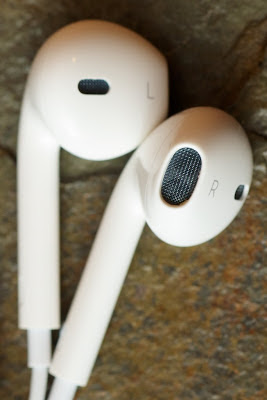
A redesign of an common idea. A unique shape
and one that I can actually, finally, wear for long
periods of time. Oh, and £25.


Saturday, 17 November 2012

Two Towers...

A quickie post. This to illustrate why press photographers often say we aren't specialists; we have to be able to get something from anything. It might not be great, but it will pretty much always be useable...

The brief here was to photograph two blocks of luxury flats, built on St Mary's Island, Chatham. One is still empty, despite being completed for some years now...

From the list, the newsdesk had already decided the shot needed to be after dark to show the lights on in one, the other dark.

1) Look at time it will be done (earlier jobs on list) - will miss twilight and sky colour, which means it could be a dark building against a dark sky. Grrrr...
2) Check forecast. Aha, yes!! Cloudy evening forecast! It's not quite the same, but I'll be grateful for light pollution today, as there's a good chance the clouds will be lit up by the town lights below.
3) Find a location. Not too difficult, the buildings can be seen in their entirety from St Mary's Island proper, looking back into the mainland.
4) Arrive at gone 7.30pm. It's cold. Grab coat, torch, tripod and kit.
5) Set up, right by the water's edge, Camera D3S, lens 24-70 f2.8. ISO set to 400, aperture to f5.6. Focus camera, turn focusing off.
6) Stand and look at scene and camera settings, say "Meh! Start at 10 seconds..."
7) Set self-timer on camera (to minimise vibration) and press the button.
8) Watch image pop up on LCD screen. Smile to self. Pretty close from the outset...

Anything else was just adjusting the shutter speed/aperture combination to give slightly darker or lighter images choices, plus upright and view versions.

St Mary's Island Apartments.
Enough light reflecting back from the clouds to see the buildings on their own, yet also see that one is lit, the other
not. And all surrounded by the lights of Chatham Maritime.
Nikon D3S, 24-70 f2.8 AFS, 15 seconds, f7.1, ISO 400. Tripod. With a mix of lights,
I let the Auto White Balance do its thing and decided I rather liked what it had made of the scene...


Monday, 22 October 2012

More GLOWing boxing...

Here's a further small selection of images from the boxing tournament at the Glow Arena at the Bluewater shopping complex, held on 13th October.

Technically, as I've noted already, the TV lights made things a bit easier than the amateur tournaments I've done up til now. These are often in very gloomy school sports halls with the ISO jammed against the upper reaches of even a D3. Here at Glow, with the TV lights, ISOs were a slightly more sensible 2500/3200, which is well within the capability of the D3S bodies I have now. Exposure was 1/640th at f4 on the 24-70, for just a little helpful depth of field. I also used my 70-200, but this lens, truth be told, is a little darker than the nominal f2.8, so I used f3.5 and the higher of the ISO settings.

White balance was also fairly simple, though I still tweaked the raw files for skin tone. A couple of quick snaps of my hand suggested the Tungsten preset, with a little extra warming (A2?) dialled in. This gave me reasonable Jpegs out of camera, though a fully-custom white balance is the way to go if shooting 'peg exclusively.

The AF setting was Continuous, with a point set which is off-centre, and used this way from previous experience. I'm not sure if this is the way the boxing "regulars' work, but it's what seems to do for me. What you do is keep the off-centre point over the boxer on that side, assuming they are broadly parallel to you, and let the camera do it's thing.  9 or 21 Point selection was active here. I might try the 3D option at the next amateur bout and see how that will work. But for now I stuck with what I was familiar with and knew did work OK.

I'm still not sure I rate Pro boxing very much. It's not a sport I seek out on TV, for example. The much longer bouts of the main events, 12 rounds, seemed to drag and just give shot after shot that looked, well, the same. Although I had over 2300 images by the end of the evening, I found I was shooting much more sparingly by the final headline fight. Amateur boxing, with its head-guards, short bouts and less "cuddling" between boxers (less blood, too...) seems much more interesting to me. It doesn't attract the big bucks, of course...


Right. Enough techie stuff. The pictures...


Lenny Daws, left, fights Ville Piispanen for the vacant EU Super Lightweight Championship.
D3S, 24-70 at 32mm. The wider shots looked nice, with the lights putting the ring brighter than the
rest of the hall. School sports hall lighting just can't do this, so I don't shoot the very wide images there.

More after the break...


Monday, 15 October 2012

The GLOW of boxing...

A quickie post...

The Bluewater shopping centre in Kent hosted a series of boxing matches on Saturday 13th October, in the complex's new Glow Arena. The event was headlined and topped off by James DeGale's defence of his EBU Super Middleweight title and so I took up my ringside position for the evening, and tried to remember how to shoot the sport.

I've only shot amateur boxing until now, in gloomy school sports halls, so this televised event meant that there was actually some decent lighting...

Here's a picture from a fight earlier in the evening, with local boxer Adam Dinsdale, from Hoo, up against Ibrar Riyaz.

Adam Dinsdale, right, from Hoo, Kent, on his way to beating Ibrar Riyaz in this lightweight bout.
Nikon D3S, 1/640th @ f4,  24-70 f2.8AFS at 70mm, 2500ISO.
More pics to follow in a few days.

Wednesday, 3 October 2012

Summer of Sport, Pt 2...

Or, " You shall go to the Olympics..!"

OK, I confess to being something of an Olympo-sceptic on the build-up to London 2012.

Various ministers trying to claim the event was under-budget, the seemingly totalitarian powers granted to LOCOG, the enforcement of Olympic branding restrictions to a stupid degree (Little Chef's Olympic Breakfast, available for many years, for heaven's sake!), latterly even the abject failure of private company G4S to understand what it needed to do to fulfil it's contracted security commitments...

I thought the Torch Relay around the UK was over-egged, but sitting on the back of the media bus showed me that plenty of people were really looking forward to the event, and my mood began to shift.

Then there was Danny Boyle's truly wonderful opening ceremony, Jacques Rogge's very generous opening speech, the Queen and 007 "parachuting" into the show and suddenly it was clear the bulls**t had stopped and London 2012 was going to be fantastic. Even the weather, pretty dire through spring and summer, largely cooperated!

And the medals started to come. Women's events are the biggest growth area of sport and  fittingly it was the Team GB women who put the first ones on the board, with Lizzie Armitstead's cycling silver and Becky Adlington's swimming bronze. Then rowers Heather Stanning and Helen Glover won the coxless pairs for the first GB gold. The men stepped up, and Team GB ended in third place in the medal table, remarkable for a tiny island with a (still) relatively small population.

Then it was the turn of the Paralympians to take the stage.

And here, I actually got to see some London 2012 action, when I hadn't been expecting to do so...

More after the break.

Tuesday free practice, D3S plus 300 f2,8 and TC14EII (=420mm), pretty much the combination used for most of
my time, unless it was a close-in shot or obviously a wide angle view.